Blog
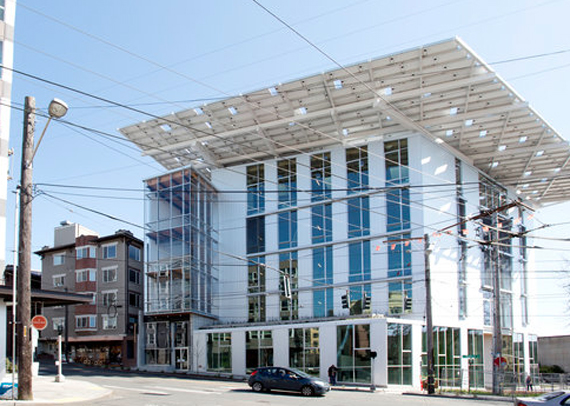
Just a year and a half since the Guardian announced the construction had begun, the Bullitt Center, Seattle’s carbon-neutral energy and net-zero water building has welcomed its first occupants for its grand opening on Earth Day, April 22nd. Located at the edge of Capitol Hill, the six-story building is estimated to function at 83 percent more efficient than the city’s average commercial site.How is it possible? All the water will be supplied by rainwater; collected, filtered and disinfected. Additionally, the project’s backers have instilled strict electricity usage budgets and detailed outlet meter readings so that management can pinpoint where energy is being used.
The New York Times published an article earlier this week outlining details on how the Bullitt Center evolved from an idea to reality and how its creators hope their strategy and building plans may act as a model for how we can live responsibly within beautiful sunlit rooms. In the meanwhile, the building must undergo a year-long process of certification called the Living Building Challenge, to determine if it is in fact self-sustaining. Should it pass all regulations, it will be the largest of four qualifying buildings in the United States. Check out the NYT slideshow here and follow up to see how the Bullit Center occupants respond to composting toilets, lack of onsite parking, and the gorgeous views of Puget Sound.

Apr 12, 2013 | Categories: Sustainability | Comments Off on Seattle’s Bullitt Center
 If you are in New York this weekend, check out the photo show at Lost Weekend. It features the art work of talented local photographer, Tommy Colla.
Where: Lost Weekend: 45 Orchard St, New York, NY.
When: April 11th, 7PM-10PM
More info here.
Apr 11, 2013 | Categories: Creative Culture, New York City | Tags: creative culture, New York | Comments Off on Photo Show: Lost Weekend NYC
An excellent way to get involved with (or continue to work on) Sandy recovery efforts in Rockaway is to join this Kickstarter campaign for an environmentally sustainable, pay-as-you-can community kitchen providing access to healthy, local food. Check it out! Only 24 more days left to help!
Apr 10, 2013 | Categories: New York City, Sustainability | Comments Off on Rockaway SHORE Relief Restaurant

To celebrate their 125 years of existence, National Geographic have launched an official Tumblr dedicated exclusively to showing off a wide array of photographs from their historic archives, many of which have until now been unpublished. The result is equal parts journey back in time and inspiration for preserving and cultivating our cultures and environments. Quite possibly the most interesting thing about the collection is the unlikely sight of animals and nature amidst everyday life that seems sorely missing today. From a woman sitting atop an emu, to another hitching up a horse to a parking meter, the blog is sure to make you yearn for a little more wild in your life.


Apr 09, 2013 | Categories: Archives, Nature | Comments Off on National Geographic Found

New Yorkers have recently benefitted from exhibitions of little-known (on these shores, at least) Italian artists whose work from the 1960s, ’70s, and ’80s is quite spectacular. First there was an exhibition at Casey Kaplan Gallery of folded and graphically treated paintings by Giorgio Griffa. (That’s one of them above.) Then there was the work in multiple mediums by Gianni Colombo, which was on view until the end of March at Greene Naftali. You can see pictures of that exhibition by clicking here.
Apr 08, 2013 | Categories: Creative Culture, New York City | Tags: Italian art, painting | Comments Off on Italian Art of the ’60s, ’70s, and ’80s in New York

Harmony Korine’s Spring Breakers is ostensibly a beach movie, thus earning a place on the Harmony blog, right? I hope so, as it gives me an excuse to post my favorite review of the film thus far, by Amy Taubin for Artforum.com. A sample:
When the camera has its fill of gravity-defying boobs, it switches to buttocks, and then to hot-pink-tinted lips fellating red, white, ’n’ blue popsicles, then back again, over and over until you might wonder when the story is going to begin or if this giddy, tawdry, MTV-on-ecstasy spectacle is all there is—a visual ground for the movie’s genius ambient sound track that punctuates Cliff Martinez’s anxiety-driven electronica with Skrillex’s dub-step riffs and intermittent backbeats of assault rifles cocked or fired. Close your eyes and make up your own pictures. Because some of those on the screen, their dazzling mix of pop excess and stringent form notwithstanding (even Warhol stuck to halftones for the “Death and Disaster” paintings), are just too ugly. And I’m not referring only to the glimpse of the kid passed out or maybe dead on the floor beside a stopped-up toilet. Did she OD on Skittles? Can a movie be too colorful to swallow?
To read the rest, click here.
Apr 04, 2013 | Categories: Creative Culture | Comments Off on For-ev-ah Young

Suzan Frecon, cathedral series, variation 10, 2012, oil on wood panel, 12 x 9 3/4 inches
Rail: Do you think of your paintings as being derived from nature?
Frecon: Oh, I think nature is a given. It’s impossible to say we aren’t from nature. To me, nature is everything and I don’t put it in those terms where you say they derive from nature but—I was always trying to figure out—I know how important the environment is to me, and I am always so angry against the environmental terrorists, i.e. the Bush administration who seems hell-bent on destroying it! I can never explain how important it is to art. One way is the experience of looking, walking in the woods, looking at a sunset, is comparable to the experience of looking at art or listening to music. It’s just so much a part of the soul of humanity. When you are looking at the Cézanne for example, or a Pomo basket, you just feel strongly about this captured feeling. I would love it if I could aspire to capture something comparable in my paintings.
Rail: You mean something fleeting that’s at the same time completely structured?
Frecon: It’s just innate. One painting that I am working on, actually I think the beginning came from that I grew up on an orchard and I was eating plums, and the colors were so intense in the summertime, inherent in plums, that I said I’ve got to do a painting finding something of these colors.
Read on.
Apr 03, 2013 | Categories: Creative Culture | Comments Off on Suzan Frecon, cathedral series, variation 10

Though the links between earthquakes and human activity have long been discussed, evidence is gathering that strongly correlates the use of fracking to obtain fuels from the earth to these natural disasters. Mother Jones recently published Michael Behar’s account of an unlikely 5.7 quake in Oklahoma in 2011, and the manmade circumstances that appear to have led to it.
The piece is an interesting read, not just for the single case study, but for the very idea that we as people can indirectly cause a massive shift in our environment. In this case, it may not matter to what extent we are to blame for certain disasters, but we may want to take it as a caution to do whatever we can to avoid setting certain fates into motion.
Apr 02, 2013 | Categories: Nature, Sustainability | Comments Off on Fracking and Earthquakes



